
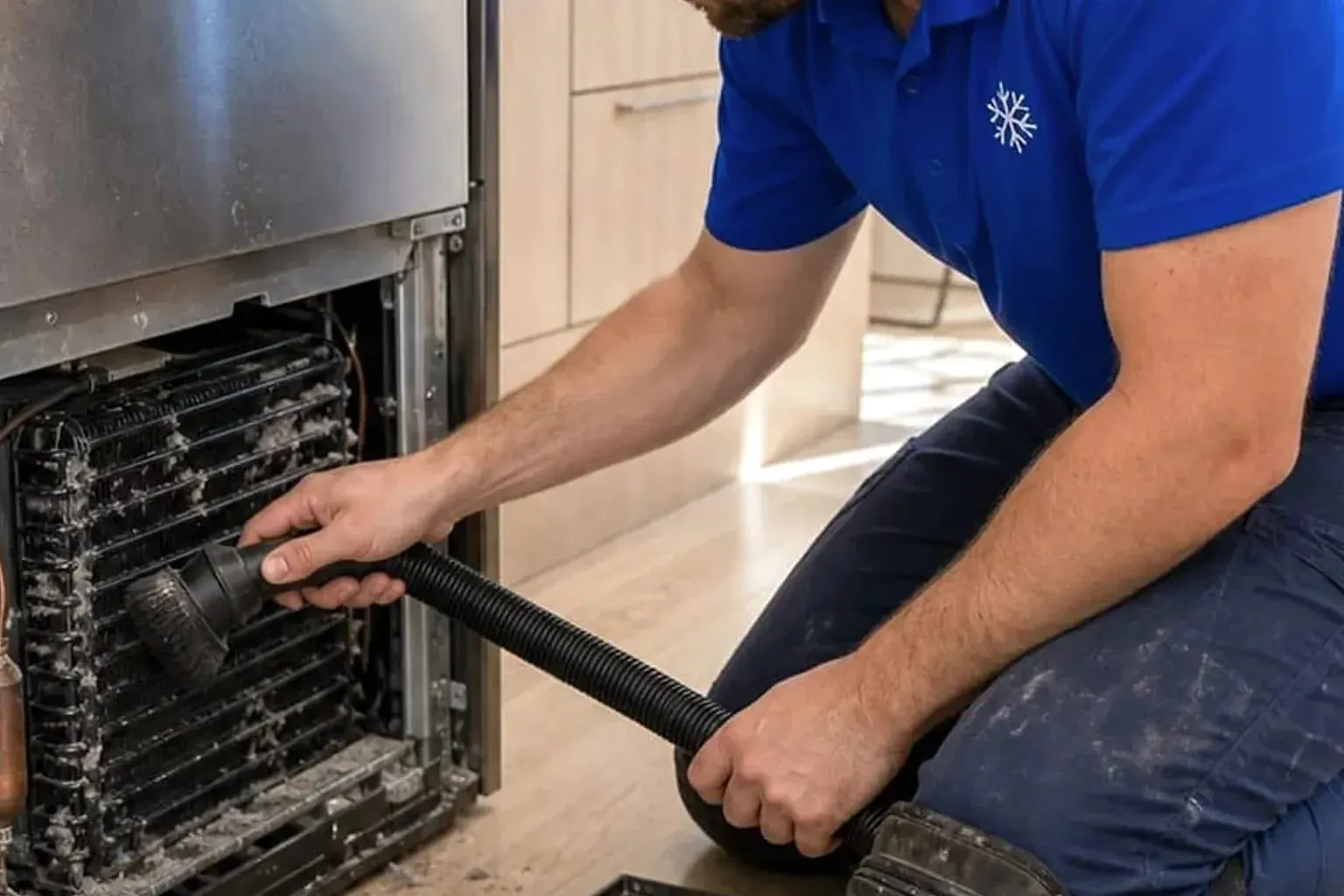
A fridge ices up at the back because the evaporator coil behind the rear panel runs far below 32°F, so humid air or melt water that reaches it freezes instead of draining away. In a Sub-Zero built-in, that ice usually traces to one of 3 faults: a door seal letting kitchen air in, a defrost cycle that no longer clears the coil, or a blocked drain that refreezes the melt water.
A built-in Sub-Zero blows cabinet air across that rear coil, then relies on a defrost cycle and a drain to remove the frost collected there. When any link breaks, the coldest surface shows it first, and the shape of the ice tells you which link failed.
What sits behind the back wall of a built-in refrigerator?
Behind the rear panel of a Sub-Zero built-in sits the evaporator, a finned coil where refrigerant boils and pulls heat from the cabinet air. A small fan draws air through the fins and back out through vents, so the rear panel is the coldest surface inside. Below the Sub-Zero coil, a trough catches melt water and feeds a drain tube to a pan near the compressor, where condenser warmth evaporates it.
Sub-Zero's Classic Series guide describes Dual Refrigeration as separate refrigerator and freezer systems that keep fresh-food odors out of frozen food and ice and do not freeze the moisture out of the fresh-food air. That moist air is deliberate, so the refrigerator-side Sub-Zero coil works close to the point where water vapor turns to frost.
Why does the back of my fridge ice up instead of the front?
Water vapor condenses on the coldest surface it can reach, and in a Sub-Zero refrigerator that is the evaporator and its cover. Each door opening lets warm kitchen air in; the fan pulls it toward the coil, where its moisture lands as frost. A thin, even dusting that comes and goes is normal.
Ice that keeps building means more moisture arrives than the Sub-Zero defrost cycle can remove, or the melt water has nowhere to go. A leaking door gasket feeds the coil all day, and uncovered warm leftovers or a crisper jammed against the rear vents make it worse. Placement is a clue too: frost near the top follows the air path, while a clear sheet at the bottom follows the water path to the drain.
How should the defrost cycle clear that frost?
A Sub-Zero freezer coil stays below freezing, so it needs active help. At intervals set by the control, cooling pauses and a defrost heater on the coil switches on; a temperature sensor ends the cycle once the coil warms past freezing, and the melt water drains away. The fresh-food coil in a dual-system Sub-Zero usually sheds its frost during the compressor's off time, because that compartment sits above freezing.
If the Sub-Zero defrost heater, the sensor that ends the cycle, or the control board fails, frost never fully clears. Each cycle adds a layer, the layers fuse into solid ice, and the ice chokes the airflow. Owners often notice the cabinet warming before they spot the ice.
Matching the ice pattern to the likely cause
Even white frost across the rear panel and a sweaty door edge: a Sub-Zero door gasket is letting humid air in. Close the door on a dollar bill at several points; little or no drag marks a gap. Call if the gasket is torn or the door sags; gasket and frost-line work runs $400-$900.
A clear ice sheet along the bottom of the rear wall, or water under the crisper drawers: the Sub-Zero defrost drain is blocked, so melt water pools and refreezes. If it returns after you wipe it up, call; clearing the drain means removing interior panels.
Thick frost on the freezer's evaporator cover while the refrigerator side drifts warm: the Sub-Zero defrost system has failed or ice has locked the evaporator fan. Press the door switch and listen for the fan, then call; evaporator fan repairs run $280-$650.
Ice around the ice maker at the rear of the freezer: a weak fill can freeze in the Sub-Zero fill tube and spill down the wall. Sub-Zero requires 20-100 psi or 35-120 psi depending on model and supplies no gauge, so have a plumber confirm it.
Patchy frost on part of the rear panel with weak cooling: a low charge in the Sub-Zero sealed system. Household circuits using R-600a, R-290 or R-441A are capped at 150 grams (5.29 ounces) under UL 60335-2-24, so a small leak matters. That is technician work; sealed-system repair runs $1450-$3600.
What can you safely do before booking a visit?
Start with the free checks: confirm the Sub-Zero setpoints have not been bumped colder, clear anything blocking the rear vents, and keep door openings short for a day.
For built-up ice, a full manual defrost is the safe reset. Switch the Sub-Zero off, move food to coolers, lay towels down, and leave the doors open until the ice melts on its own, which can take most of a day. Never chip at the rear panel; one slip can puncture the tubing behind it.
Before you call, find the serial tag: inside the cabinet left of the freezer drawer on a PRO3650, left of the upper freezer drawer on a PRO4850 or 648PRO, and on the cabinet ceiling of DEU undercounter units.
When is ice at the back a job for a technician?
Book a technician when ice returns within a few days of a full defrost, when the cabinet warms as the ice grows, when the evaporator fan grinds or stops, or when the door gasket is visibly damaged. Each points to a failing Sub-Zero part, not a habit.
A Sub-Zero visit in Sunnyvale, from Cherry Chase and Birdland to Lakewood Village, starts with the $89 service-call fee, which is waived if you go ahead with the repair.