
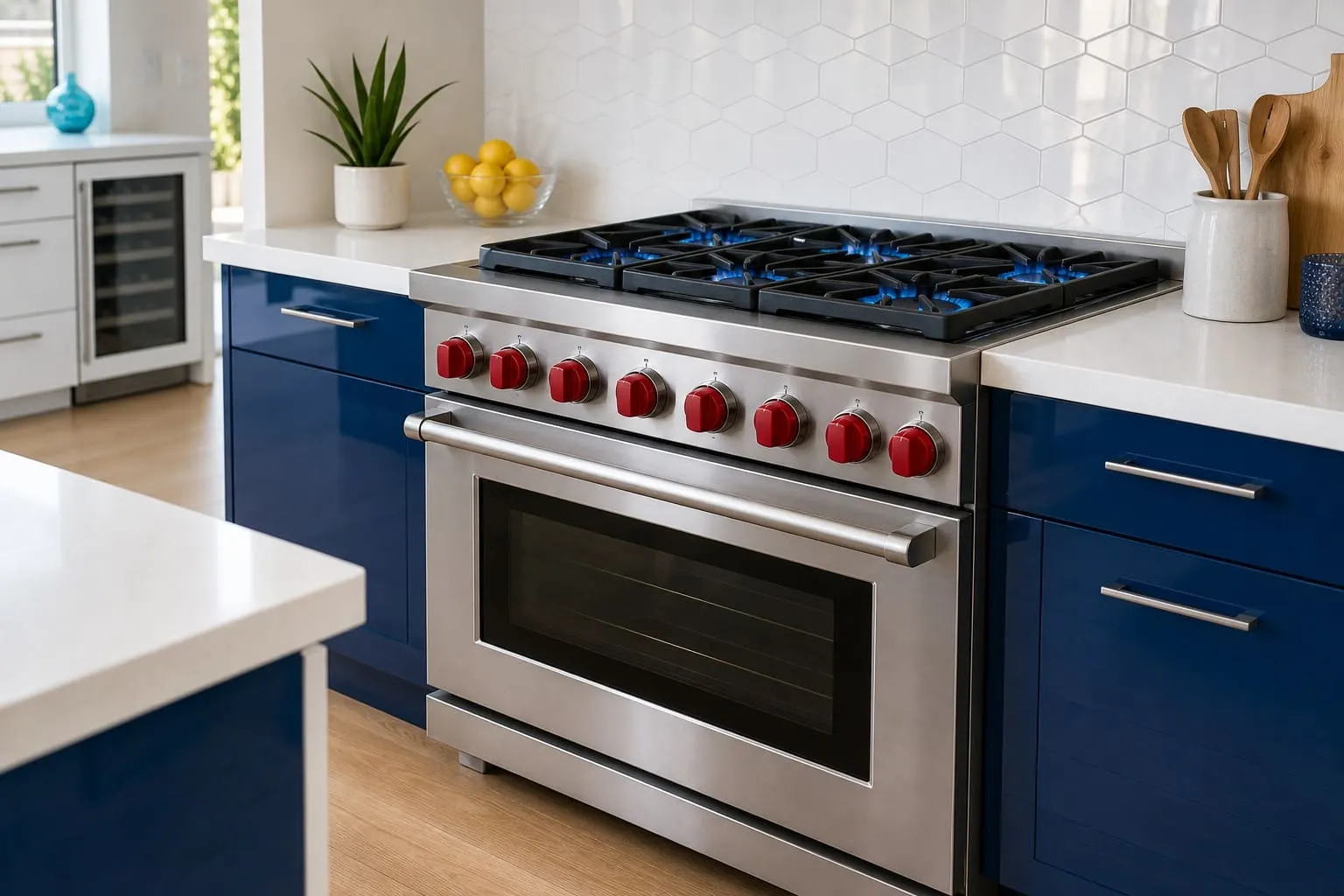
An oven that smells like gas for a few seconds while the burner lights is normal, but a rotten-egg odor that lingers more than 1 minute after ignition, or appears with every knob off, is a possible gas leak. If the odor is strong, leave the house, touch no switches, and call the gas utility or 911 from outside; if it is faint, turn the knobs off, open a window and close the range shutoff valve with a quarter turn.
This guide covers built-in and pro-style cooking equipment, such as a Wolf all-gas range or rangetop and Thermador, Viking or Monogram ranges, in Sunnyvale homes from the Heritage District to Lakewood Village.
Is a gas smell from the oven ever normal?
A brief whiff of gas at ignition is normal on a gas oven. Most residential gas ovens light the bake burner with a glow-bar igniter that heats for roughly 30 to 60 seconds before the safety valve opens, so a little unburned gas escapes just before the flame catches. On a healthy gas oven that odor fades within a minute.
Several oven smells are not gas at all. A new Wolf or Thermador oven smells of hot oil for its first few cycles as manufacturing residue burns off, a self-clean cycle smells sharp and smoky, and a spill on the oven floor smells like burnt sugar. Natural gas itself is odorless; utilities add a sulfur compound called mercaptan so a leak smells like rotten eggs, and that sulfur note is the one to take seriously.
The first five minutes: strong odor versus faint odor
A strong gas odor, an audible hiss, or a smell filling more than one room is an emergency. Get everyone, pets included, out of the house. Do not flip switches, unplug anything, or light a flame, because one spark can ignite gas. Call the gas utility or 911 from outside, and let the utility clear the home before anyone returns.
A faint odor confined to the range calls for a calmer routine. Turn every burner, griddle and oven knob on the Wolf or other pro-style range to off, open windows, and close the appliance shutoff valve on the line feeding the range; a quarter-turn valve is closed when its handle sits crosswise to the pipe. If that valve can only be reached by sliding a built-in range out of the cabinetry, leave the range in place, because dragging a heavy range can strain a leaking connector.
Where does the gas smell come from on a Wolf or pro-style range?
A Wolf dual-fuel range and a Wolf wall oven both bake with electric elements, so a gas smell near either one comes from the cooktop burners, the burner valves or the supply connection, not the oven cavity. Only an all-gas range, such as a Wolf gas range or an all-gas Thermador, Viking or Monogram model, burns gas inside the oven.
On an all-gas range, the usual sources fall into 5 groups. A weak glow-bar igniter heats slowly, so gas pools briefly and lights with a soft whoomp. A bumped cooktop or griddle knob releases gas at a burner that never lit. A loose or worn flexible connector behind the range seeps continuously, often after the range was slid out for flooring or cabinet work during a remodel. A failing regulator, safety valve or burner valve leaks at its seat or threads. Poor combustion from clogged burner ports or an orifice set for the wrong gas type brings a tall yellow flame, an acrid smell and soot.
How can an owner check for a gas leak safely?
Once the knobs are off and the room has aired out, an owner can run 4 checks on a Wolf or other pro-style range without opening a panel. First, sniff around the knobs, the cooktop burners and the oven vent; natural gas rises, while propane settles low.
Second, brush soapy water onto any connection reachable without moving the range, such as the shutoff valve and the start of the flexible connector. Growing bubbles mean escaping gas. Never hunt for a leak with a flame.
Third, if the soap test shows nothing and the odor has not returned, reopen the valve and light one cooktop burner: a steady blue flame is healthy, while tall yellow or orange flames signal a combustion problem. Fourth, watch the oven light through the door window; the bake burner should light within about 90 seconds.
Owners should not tighten gas fittings, remove the back panel, swap the igniter or adjust burner air shutters. Keep a working carbon monoxide alarm near the kitchen, because carbon monoxide from poor combustion has no smell.
When does an oven gas smell need a technician?
Book a technician whenever the gas odor returns after airing out, appears with every knob off, follows a soap-bubble hit, or arrives with delayed ignition, yellow flames, soot on the oven ceiling or a CO alarm. The same applies after a range has been moved, reconnected, or converted between natural gas and propane. If the smell began within days of remodel work in a Cherry Chase, Birdland or Ortega Park kitchen, mention that timing when you book.
A technician servicing a Wolf, Thermador, Viking or Monogram range checks the supply with an electronic combustible-gas detector, measures manifold pressure with a manometer against the rating plate, tests igniter current, and inspects the regulator, valves, burner orifices and flexible connector. Very old uncoated brass connectors get replaced, never tightened. The fix is usually a part swap followed by a leak test.
Sub-Zero Sunnyvale Service Co. charges an $89 service call, waived when the repair goes ahead. An igniter or connector is a modest part, a regulator or safety valve costs more, and labor rises when a built-in range must be eased out of tight cabinetry.